
How to Write a Capability Statement
A capability statement is often the first document a buyer sees. It tells them who you are, what you do, and whether you're worth talking to.
Get it right and you're in the room. Get it wrong and you're ruled out early.
This guide covers what to include, what to leave out, and how to structure a capability statement that actually works.
What is a Capability Statement?
A capability statement is a short document (usually 2–4 pages) that summarises your business, experience, and capacity to deliver.
It's used by:
-
Government agencies evaluating potential suppliers
-
Head contractors reviewing subcontractors
-
Commercial buyers during prequalification
It's not a brochure.
It's not a company history.
It's a snapshot of what your business is capable of delivering, written for someone who needs to make a decision quickly.
The same issue shows up in tenders. General claims don’t get scored. If you want to understand how evaluators assess submissions, read this.
If you’re also responding to tenders, this becomes even more important. Here’s how to win government tenders.
Why Do You Need a Capability Statement?
Most businesses don't get ruled out because they can't do the job. They get ruled out because they can't prove it fast enough.
A capability statement is often the first filter. Before anyone reads your tender response, reviews your quote, or picks up the phone, they check whether you're worth considering.
It's used at three key decision points:
Prequalification. Government agencies and head contractors use capability statements to build shortlists. If yours doesn't stack up, you don't get invited to quote.
Panel applications. When you apply for supplier panels, your capability statement is usually a mandatory attachment. A weak one costs you a seat at the table.
Tender responses. Even when it's not required, it's often referred back to during assessment. It shapes how the rest of your submission is read.
The businesses that win work aren't always the biggest or the cheapest. They're the ones who make it easy for buyers to say yes.
The same issue that causes tenders to lose also shows up in capability statements.
General claims don’t stand out.
What to Include
-
Business overview. Who you are, where you operate, geographic coverage, ABN, structure.
-
Services. What you deliver, in plain terms.
-
Experience. Relevant projects, contract values, client types.
-
Capacity. Team size, equipment, availability.
-
Credentials. Licences, insurances, accreditations, certifications.
-
Key personnel. Who's doing the work and what's their background.
-
Contact details. Make it easy to reach you.
If it doesn't help someone decide whether to engage you, cut it.
-
Mission statements and corporate waffle
-
Irrelevant project history
-
Jargon and buzzwords
-
Stock photos
-
Anything you can't back up with evidence
What to Leave Out
Common Mistakes
After reviewing hundreds of capability statements, the same issues come up again and again.
Leading with company history
Nobody cares that you started in a garage in 1987. Buyers want to know what you can do for them now. Save the origin story for your website.
Too long
If your capability statement is 8-10 pages, it's not a capability statement - it's a company profile.
Aim for 2-4 pages. If you can't summarise your capability in that space, you don't know your capability well enough.
No specific evidence
"We have extensive experience in commercial projects" is generic fluff and means nothing.
What projects? What contract values? What clients?
Proof beats promises every time.
Policy-heavy content
Listing every policy you own doesn't demonstrate capability - it just shows you have a filing system.
Reference key accreditations and certifications only.
Detailed policies belong in compliance checks.
Generic descriptions
If your competitor could copy and paste your services section and it would still apply to them, it's too generic.
Be specific about what you do, where you do it, and for whom.
Wrong Audience
A capability statement for a head contractor looks different to one for a government agency. If you're using the same document for everyone, you're probably missing the mark for everyone.
How to Stand Out
The difference between a capability statement that gets filed and one that gets you shortlisted usually comes down to three things.
Lead with proof, not generic promises.
Don't open with "We are a leading provider of quality services." Open with what you've actually delivered. Project names, contract values, client types, locations. Let the evidence do the talking.
Make it easy to scan.
Buyers are busy. They're not reading your capability statement cover to cover, word by word, they're scanning for the bits that matter to them.
Use clear headings, keep paragraphs short, and put your strongest proof points where they can't be missed.
Match the buyer's language.
If you're targeting government work, use the terminology they use. If you're chasing builder work, speak like a contractor. Mirror their priorities back to them so they can see you understand what they need.
Show capacity, not just capability.
It's not enough to prove you've done the work before. Buyers want to know you can do it again, on their timeline, at their scale. Team size, equipment, geographic coverage, availability. Show them you can deliver.
Not Sure Where Yours Stands?
Most capability statements have gaps the business owner can't see
simply because they're too close to the document.
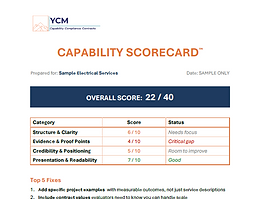
The YCM Capability Scorecard™ is a personalised, completely
confidential assessment where I review your capability statement and
score it across four key areas:
-
Structure & clarity
-
Evidence & proof points
-
Credibility & positioning
-
Presentation & readability
You’ll receive a score out of 40, a clear breakdown of what’s working and what isn’t, and specific, practical recommendations to strengthen your document - all informed by 20+ years' experience in government procurement.